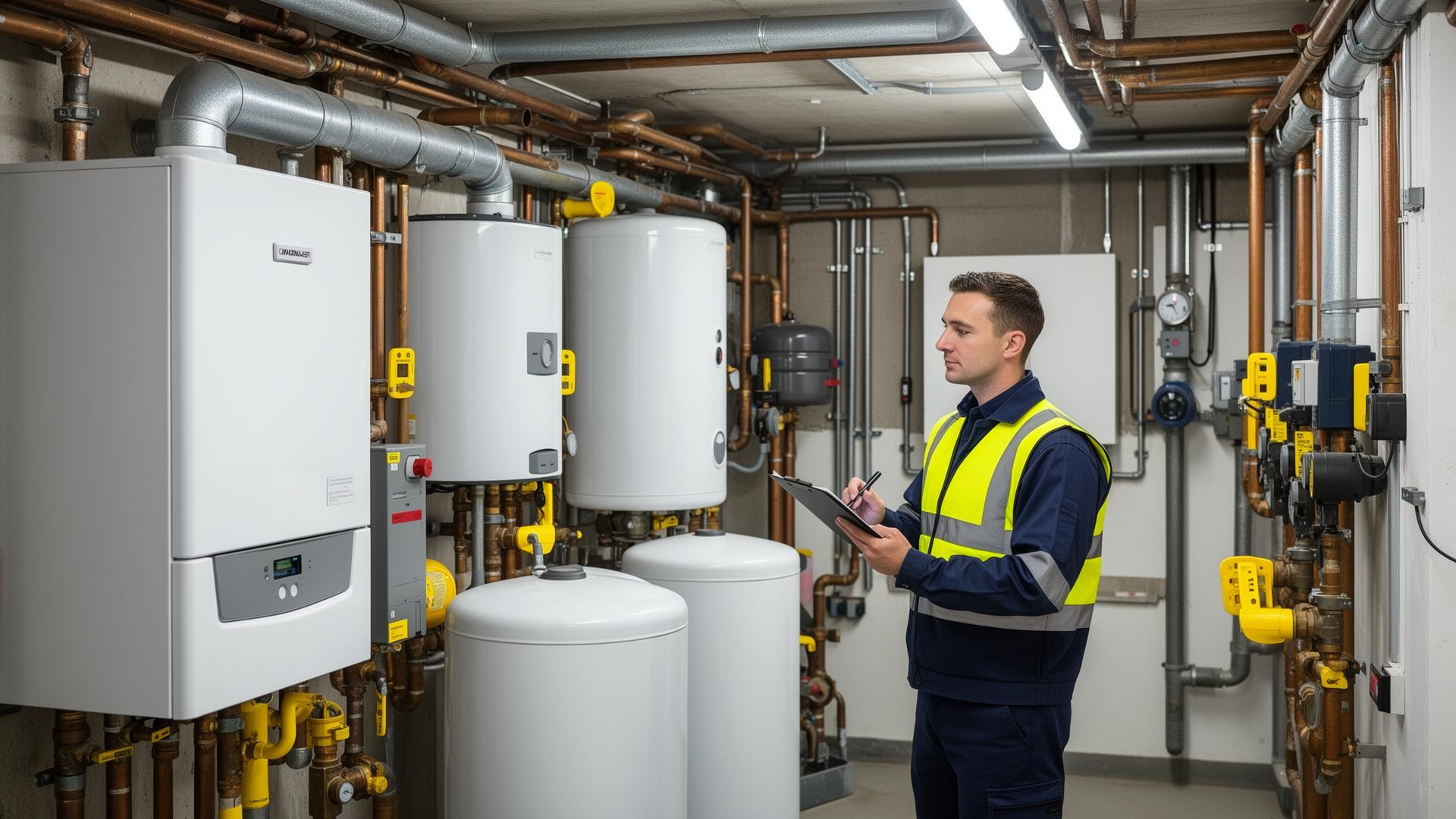
Commercial Gas Services London
Installation, repairs, servicing, maintenance and emergency call-outs for commercial gas systems across London.
We work for offices, restaurants, hotels, schools, care homes, churches, warehouses, retail units and residential blocks with communal plant across London, including City of London, Westminster, Camden, Islington, Hackney, Tower Hamlets, Southwark, Lambeth, Kensington & Chelsea, Hammersmith & Fulham, Wandsworth, Greenwich and every other borough.
Understanding commercial gas services
Every commercial building that burns gas relies on pipework, appliances and safety controls that must be installed, maintained and tested by an engineer holding the right non-domestic Gas Safe categories. Our engineers carry commercial competencies (COCN1, CENWAT, ICPN1, TPCP1A and related ACS qualifications), so the work we sign off is valid for insurers, landlords, local authority inspectors and fire risk assessors.
Start with the reason for the visit: a new supply, a recurring fault, a planned service or an urgent loss of gas. The engineer needs to know which appliances are affected, whether the problem is isolated to one item or the whole building, and whether anybody has already turned off a valve. An appliance data plate, previous service report and clear access to the meter and plant room help separate a supply problem from an appliance fault. A report of a gas smell is treated as a safety issue, not a routine booking.
Tell us what you need to keep running at the premises, what has stopped working and which equipment is involved. The correct starting point depends on the actual installation, not simply the description of a symptom. An engineer can then assess the site and explain whether the work is a safety inspection, a diagnosis, a repair or a planned change. If you have previous test or service records, make them available at the visit so any repeated issue can be investigated in context.
Selecting the appropriate work
The next step depends on the condition of the installation. A repair may be appropriate when a failed component can be identified and the rest of the system remains sound. Repeated shutdowns, obsolete controls or undocumented alterations may instead call for a wider survey. If a new appliance is proposed, the existing pipe size, available pressure, ventilation and flue route must be considered together. Replacing a boiler or cooker without checking its supply can leave the original problem unresolved.
There are 9 entries in this group, covering different appliances, checks or kinds of visit. Choose the page that matches the actual work you need rather than booking a general inspection in place of a repair. Some jobs require more than one stage: an installation may need testing, purging and commissioning; a breakdown may need diagnosis followed by a separately agreed repair. We will define the scope with you before additional work proceeds.
If more than one system is affected, identify a responsible person who can approve an isolation or a change in plan on site. Give the engineer access details for meters, plant rooms and controls as well as the appliance itself. Where tenants, staff or customers could lose heating, cooking or hot water, agree the suitable working window and contingency arrangements in advance. Safety concerns are dealt with before convenience or continuity of service.
Safety, competence and standards
Work is carried out to the Gas Safety (Installation and Use) Regulations 1998, IGEM/UP/1 and IGEM/UP/1A for testing and purging, IGEM/UP/2 for installation pipework, BS 6644 for larger boiler plant and BS 6173 for catering appliances.
The engineer must hold the Gas Safe categories appropriate to the specific commercial appliance or work type. Check their ID card for the categories rather than assuming that registration for one gas appliance covers every commercial task. The relevant manufacturer's instructions and the installation's actual pressure, layout and condition inform the method used on site. Online descriptions can explain the process but cannot replace an on-site test, a current standard or the engineer's judgement.
Where a defect creates an unsafe situation, the affected appliance or part of the supply may have to stay isolated until the necessary repair is completed. Ask what remains usable, what must not be turned back on and what evidence is needed to return the equipment to service. A successful reset or a temporarily restored flame is not the same as diagnosing the underlying cause.
What to retain after the visit
Ask for a record that identifies the equipment, the work undertaken, measured results where relevant and any outstanding defects. Keep it with the building's gas records rather than treating the certificate as a substitute for maintenance. Where work is staged, distinguish what was made safe today from what still requires repair or commissioning. The engineer should explain any isolation clearly to the person responsible for the premises before leaving.
Before the engineer leaves, make sure you know what was inspected, what was tested, which equipment is operating and which items need follow-up. Keep the report, relevant readings, certificate or commissioning record with the site's other gas documentation. An inspection certificate only covers its stated scope and date; it is not proof that unrelated equipment has been serviced. Where several teams manage the building, share outstanding defects and restrictions with the people operating the plant.
How to prepare for the engineer
Give the site address, a contact who can open the relevant areas and any instructions for loading, parking or induction. A photo of a data plate can identify the appliance, while a previous report may identify its last measured condition. Do not open a gas appliance or enter an unsafe area to gather information. If there is a meter room, roof plant, riser cupboard or kitchen control panel, make sure the responsible person knows how the engineer can reach it.
Explain the operational effect of isolating a supply: which occupants would lose heating, which kitchens must remain open and whether other equipment shares the same branch. The engineer may need to adjust the work sequence once the installation is inspected. Agree who can approve a change to scope on site; if that person is not available, essential follow-up can be delayed. Share any restrictions with the next shift, particularly when a safety defect means equipment cannot be used.
A quote, test record and certificate are not interchangeable. The quote describes proposed work; the record describes what actually happened and the results observed. Keep both with the asset history. If a defect is identified, ask for its location, what is safe to use now and what work is needed before any isolated section can be returned to service. That creates a practical next step for a landlord, kitchen manager or facilities team rather than just a list of technical terms.
The work in this category
Commercial Gas Installation: Design and installation of new commercial gas supplies, pipework and appliances, certified to IGEM/UP/2. The work may include site survey and load calculation and pipework installation in steel, copper or mapress press-fit. It also covers appliance connection and flue checks and tightness test, purge and cp17 installation certificate. Open the service page for its scope, preparation and handover information.
Commercial Gas Repairs: Fast repairs to commercial gas appliances, controls and pipework to get your building safely back in use. The work may include diagnosis of lockouts, ignition and flame failures and replacement of valves, sensors and controls. It also covers leak location and pipework repair and safety checks and documentation after the repair. Open the service page for its scope, preparation and handover information.
Commercial Gas Servicing: Annual servicing of commercial gas appliances to manufacturers' instructions, with combustion readings recorded. The work may include strip-down and cleaning of burners and heat exchangers and combustion analysis and gas rate checks. It also covers safety device and flue integrity testing and service report with readings and recommendations. Open the service page for its scope, preparation and handover information.
Commercial Gas Maintenance: Ongoing maintenance of commercial gas plant to keep it compliant, efficient and running without surprises. The work may include scheduled inspections of plant and pipework and wear-part replacement before failure. It also covers asset register and compliance records and priority reactive cover between visits. Open the service page for its scope, preparation and handover information.
Emergency Commercial Gas Callout: Same-day emergency commercial gas callout for gas leaks, plant failures and loss of heating or hot water. The work may include rapid response across london, 24 hours a day and making safe and isolating dangerous installations. It also covers temporary repairs to restore heating and hot water and follow-up permanent repair and certification. Open the service page for its scope, preparation and handover information.
Commercial Gas Fault Finding: Systematic fault finding on commercial gas appliances, burners, controls and interlocks. The work may include electrical and gas-side diagnostics and reading controller fault logs and lockout histories. It also covers testing of pressure switches, fans and ignition and clear written diagnosis and repair quote. Open the service page for its scope, preparation and handover information.
Commercial Gas Commissioning: Commissioning of new commercial gas appliances and systems, with CP15 commissioning records. The work may include gas rate and burner pressure setting and combustion analysis to manufacturer limits. It also covers safety shut-off and flame supervision checks and handover documentation and cp15 record. Open the service page for its scope, preparation and handover information.
Commercial Gas Decommissioning: Safe decommissioning of redundant commercial gas appliances, pipework and plant. The work may include isolation and capping of supplies and purging pipework to igem/up/1. It also covers removal of redundant appliances and decommissioning certificate for your records. Open the service page for its scope, preparation and handover information.
Commercial Gas PPM: Planned preventative maintenance contracts for commercial gas plant, tailored to your building. The work may include fixed annual visit schedule and servicing, testing and certification in one plan. It also covers online records for every visit and discounted reactive call-outs. Open the service page for its scope, preparation and handover information.
Commercial Gas Services we provide
Commercial Gas Installation
Design and installation of new commercial gas supplies, pipework and appliances, certified to IGEM/UP/2.
View serviceCommercial Gas Repairs
Fast repairs to commercial gas appliances, controls and pipework to get your building safely back in use.
View serviceCommercial Gas Servicing
Annual servicing of commercial gas appliances to manufacturers' instructions, with combustion readings recorded.
View serviceCommercial Gas Maintenance
Ongoing maintenance of commercial gas plant to keep it compliant, efficient and running without surprises.
View serviceEmergency Commercial Gas Callout
Same-day emergency commercial gas callout for gas leaks, plant failures and loss of heating or hot water.
View serviceCommercial Gas Fault Finding
Systematic fault finding on commercial gas appliances, burners, controls and interlocks.
View serviceCommercial Gas Commissioning
Commissioning of new commercial gas appliances and systems, with CP15 commissioning records.
View serviceCommercial Gas Decommissioning
Safe decommissioning of redundant commercial gas appliances, pipework and plant.
View serviceCommercial Gas PPM
Planned preventative maintenance contracts for commercial gas plant, tailored to your building.
View serviceNeed a commercial gas engineer in London?
Gas Safe registered commercial engineers, 24 hours a day. Call now or book online and we'll confirm a time.
Brands we work on
Our Gas Safe engineers repair, service and install the commercial gas equipment found in London buildings. Choose a brand to see what we do.