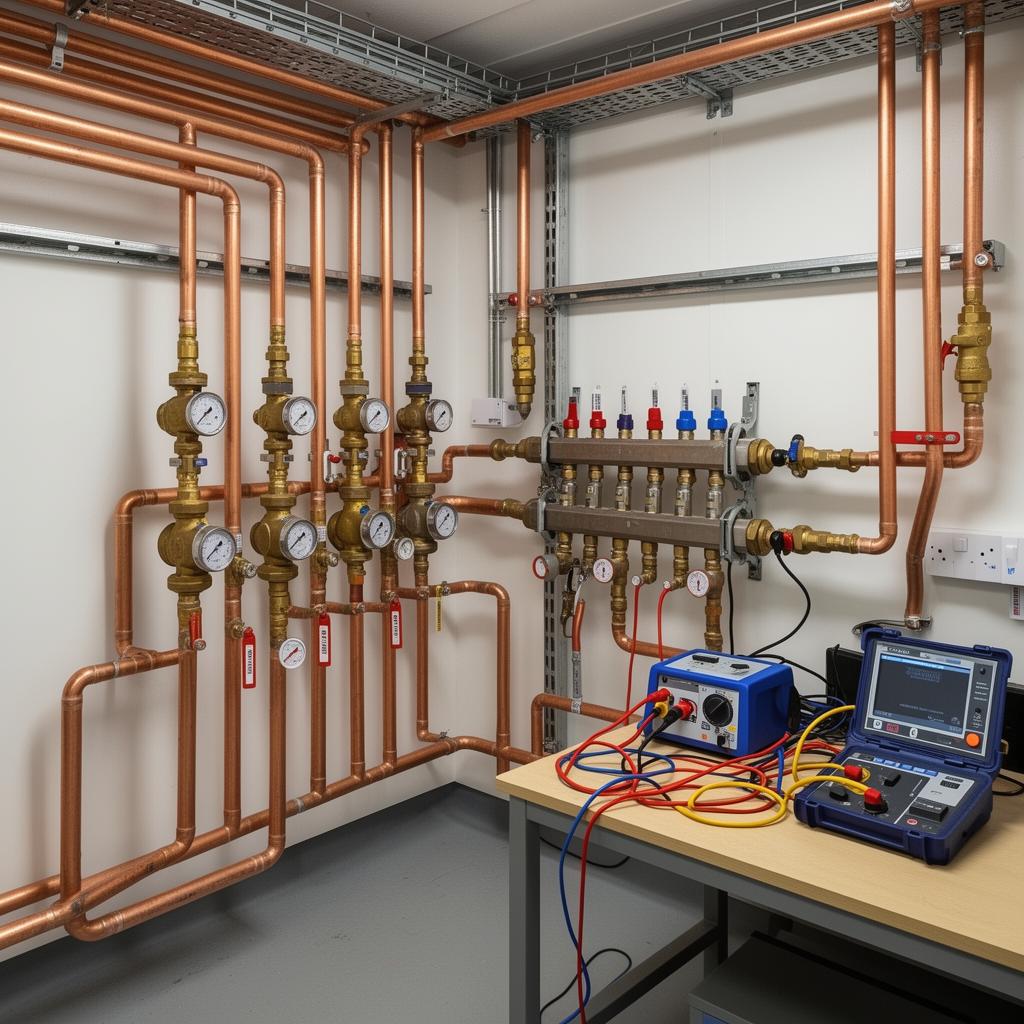
Commercial Gas Pipework London
Installation, testing, purging and repair of commercial gas pipework, risers, boosters, meters and regulators.
We work for commercial kitchens, plant rooms, factories, office blocks, residential towers with gas risers and new-build developments across London, including City of London, Westminster, Camden, Islington, Hackney, Tower Hamlets, Southwark, Lambeth, Kensington & Chelsea, Hammersmith & Fulham, Wandsworth, Greenwich and every other borough.
Understanding commercial gas pipework
Commercial gas pipework carries larger volumes at higher pressures than domestic systems, so sizing, materials, support and testing all have to meet stricter rules. We install and modify pipework from the meter outlet to every appliance, including risers in multi-storey buildings, boosters, regulators and emergency control valves.
Before a pipework visit, locate the meter, emergency control valve and appliance isolation points. Drawings are useful, but existing routes must be checked on site: concealed branches, later extensions and changes in appliance demand can affect the test boundary and sizing. The engineer establishes what section is being worked on, what appliances need isolating and whether the building can tolerate an interruption. Pressure and meter details matter because a test procedure suitable for a small installation is not automatically suitable for a larger commercial system.
Tell us what you need to keep running at the premises, what has stopped working and which equipment is involved. The correct starting point depends on the actual installation, not simply the description of a symptom. An engineer can then assess the site and explain whether the work is a safety inspection, a diagnosis, a repair or a planned change. If you have previous test or service records, make them available at the visit so any repeated issue can be investigated in context.
Selecting the appropriate work
Pipe route, access and future isolation should be agreed before work starts. A short repair may involve one branch; a corroded or undersized run can call for replacement or redesign. Testing, purging and commissioning are separate stages and must follow the procedure applicable to the installation volume and operating pressure. Do not use an online calculator as authority to select test pressure, duration or purge arrangements; a competent engineer must verify the installation and current standard.
There are 13 entries in this group, covering different appliances, checks or kinds of visit. Choose the page that matches the actual work you need rather than booking a general inspection in place of a repair. Some jobs require more than one stage: an installation may need testing, purging and commissioning; a breakdown may need diagnosis followed by a separately agreed repair. We will define the scope with you before additional work proceeds.
If more than one system is affected, identify a responsible person who can approve an isolation or a change in plan on site. Give the engineer access details for meters, plant rooms and controls as well as the appliance itself. Where tenants, staff or customers could lose heating, cooking or hot water, agree the suitable working window and contingency arrangements in advance. Safety concerns are dealt with before convenience or continuity of service.
Safety, competence and standards
Installation follows IGEM/UP/2, testing and purging follow IGEM/UP/1 (and IGEM/UP/1A for smaller installations), meter installations follow IGEM/GM/6 and IGEM/GM/8, and risers in multi-occupancy buildings follow IGEM/G/5.
The engineer must hold the Gas Safe categories appropriate to the specific commercial appliance or work type. Check their ID card for the categories rather than assuming that registration for one gas appliance covers every commercial task. The relevant manufacturer's instructions and the installation's actual pressure, layout and condition inform the method used on site. Online descriptions can explain the process but cannot replace an on-site test, a current standard or the engineer's judgement.
Where a defect creates an unsafe situation, the affected appliance or part of the supply may have to stay isolated until the necessary repair is completed. Ask what remains usable, what must not be turned back on and what evidence is needed to return the equipment to service. A successful reset or a temporarily restored flame is not the same as diagnosing the underlying cause.
What to retain after the visit
Keep the as-fitted route information, test readings, purge record and any notices with the site documentation. Label altered valves and explain which appliances were returned to service. If part of the supply remains isolated, record precisely which part and why. On multi-tenant sites, pass that information to the building manager as well as the person who requested the job so that later contractors do not inadvertently reopen a disconnected branch.
Before the engineer leaves, make sure you know what was inspected, what was tested, which equipment is operating and which items need follow-up. Keep the report, relevant readings, certificate or commissioning record with the site's other gas documentation. An inspection certificate only covers its stated scope and date; it is not proof that unrelated equipment has been serviced. Where several teams manage the building, share outstanding defects and restrictions with the people operating the plant.
How to prepare for the engineer
Give the site address, a contact who can open the relevant areas and any instructions for loading, parking or induction. A photo of a data plate can identify the appliance, while a previous report may identify its last measured condition. Do not open a gas appliance or enter an unsafe area to gather information. If there is a meter room, roof plant, riser cupboard or kitchen control panel, make sure the responsible person knows how the engineer can reach it.
Explain the operational effect of isolating a supply: which occupants would lose heating, which kitchens must remain open and whether other equipment shares the same branch. The engineer may need to adjust the work sequence once the installation is inspected. Agree who can approve a change to scope on site; if that person is not available, essential follow-up can be delayed. Share any restrictions with the next shift, particularly when a safety defect means equipment cannot be used.
A quote, test record and certificate are not interchangeable. The quote describes proposed work; the record describes what actually happened and the results observed. Keep both with the asset history. If a defect is identified, ask for its location, what is safe to use now and what work is needed before any isolated section can be returned to service. That creates a practical next step for a landlord, kitchen manager or facilities team rather than just a list of technical terms.
The work in this category
Commercial Gas Pipework Installation: New commercial gas pipework installed in steel, copper or press-fit systems to IGEM/UP/2. The work may include route survey and pipe sizing and screwed, welded or press-fit installation. It also covers supports, sleeving and labelling and strength and tightness testing with certificate. Open the service page for its scope, preparation and handover information.
Commercial Gas Pipework Repair: Repair and replacement of leaking, corroded or damaged commercial gas pipework. The work may include leak location with electronic detection and section replacement and re-routing. It also covers corrosion protection and re-wrapping and tightness test and re-commissioning. Open the service page for its scope, preparation and handover information.
Commercial Gas Pipe Sizing: Pipe sizing calculations for new or extended commercial gas installations. The work may include load and diversity calculations and pressure drop analysis. It also covers meter and regulator capacity checks and written sizing report and drawings. Open the service page for its scope, preparation and handover information.
Gas Tightness Testing: Commercial gas tightness testing to IGEM/UP/1 and UP/1A, with CP16 certificates. The work may include installation volume calculation and test with calibrated digital gauges. It also covers let-by testing of valves and cp16 test and purge certificate. Open the service page for its scope, preparation and handover information.
Commercial Gas Purging: Direct and indirect purging of commercial gas pipework to IGEM/UP/1. The work may include purge volume and flow rate calculation and purge point and vent set-up. It also covers gas detection during purge and purge record and certificate. Open the service page for its scope, preparation and handover information.
Strength Testing: Strength testing of new and modified commercial gas pipework before tightness testing. The work may include test pressure calculation and isolation of components not rated for test. It also covers pneumatic strength test and strength test record. Open the service page for its scope, preparation and handover information.
Gas Pipework Commissioning: Commissioning of new commercial gas pipework, from strength test to gas-in. The work may include strength and tightness testing and purging to gas. It also covers appliance pressure checks and commissioning documentation. Open the service page for its scope, preparation and handover information.
Gas Pipework Decommissioning: Safe decommissioning and removal of redundant commercial gas pipework. The work may include isolation at source and purge to air. It also covers cut and cap or full removal and decommissioning record. Open the service page for its scope, preparation and handover information.
Gas Risers: Inspection, repair and replacement of gas risers and laterals in multi-storey buildings. The work may include riser condition surveys and fire-stopping and ventilation checks. It also covers lateral and riser replacement and testing and certification to igem/g/5. Open the service page for its scope, preparation and handover information.
Gas Boosters: Installation, servicing and repair of commercial gas boosters and their controls. The work may include booster sizing and selection and low and high pressure cut-off setting. It also covers non-return and bypass arrangements and annual service and safety checks. Open the service page for its scope, preparation and handover information.
Commercial Gas Pipework we provide
Commercial Gas Pipework Installation
New commercial gas pipework installed in steel, copper or press-fit systems to IGEM/UP/2.
View serviceCommercial Gas Pipework Repair
Repair and replacement of leaking, corroded or damaged commercial gas pipework.
View serviceCommercial Gas Pipe Sizing
Pipe sizing calculations for new or extended commercial gas installations.
View serviceGas Tightness Testing
Commercial gas tightness testing to IGEM/UP/1 and UP/1A, with CP16 certificates.
View serviceCommercial Gas Purging
Direct and indirect purging of commercial gas pipework to IGEM/UP/1.
View serviceStrength Testing
Strength testing of new and modified commercial gas pipework before tightness testing.
View serviceGas Pipework Commissioning
Commissioning of new commercial gas pipework, from strength test to gas-in.
View serviceGas Pipework Decommissioning
Safe decommissioning and removal of redundant commercial gas pipework.
View serviceGas Risers
Inspection, repair and replacement of gas risers and laterals in multi-storey buildings.
View serviceGas Boosters
Installation, servicing and repair of commercial gas boosters and their controls.
View serviceGas Meters
Commercial gas meter installation pipework, relocation and outlet connections.
View serviceGas Regulators
Installation, setting and replacement of commercial gas pressure regulators.
View serviceEmergency Control Valves
Installation and replacement of emergency control valves (ECVs) and additional isolation valves.
View serviceNeed a commercial gas engineer in London?
Gas Safe registered commercial engineers, 24 hours a day. Call now or book online and we'll confirm a time.
Brands we work on
Our Gas Safe engineers repair, service and install the commercial gas equipment found in London buildings. Choose a brand to see what we do.