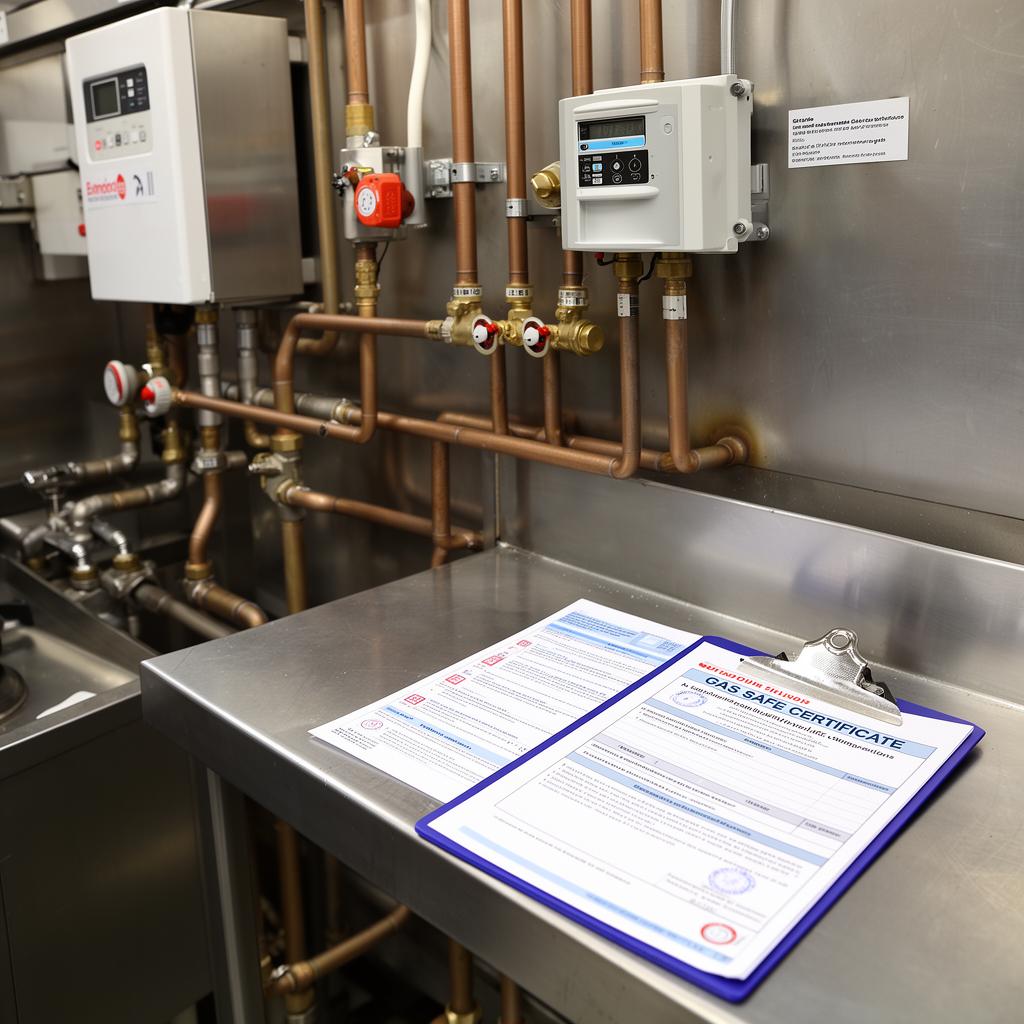
Commercial Gas Compliance by Gas Safe registered commercial engineers
We provide commercial gas compliance for businesses, landlords and facilities managers across London. Business owners, landlords and managing agents have a legal duty to keep gas installations safe. A commercial gas safety inspection checks appliances, pipework, ventilation, flues and safety controls, and the certificate is what your insurer, landlord or environmental health officer will ask to see.
Commercial Gas Compliance is part of our commercial gas safety work. Whether you manage one site or a portfolio, you get the same engineers, the same standards and clear paperwork after every visit.
Commercial gas work is different from domestic work. Loads are larger, pipework runs further and safety controls such as interlocks, valve proving and flame supervision are more complex. That is why we only send engineers who work on commercial installations every day and know the equipment found in London plant rooms and kitchens.
What's included
- Compliance audit of your sites
- Certificate tracking and renewals
- Remedial works to clear defects
- Records ready for insurers and inspectors
Before arranging a visit for Commercial Gas Compliance
Confirm what record is actually needed before booking: an appliance commissioning record, a pipework test and purge record, an installation report or a catering inspection. They document different work and are not interchangeable. Provide the engineer with an appliance list, meter location, previous certificates and access to every affected space. If a certificate is due for renewal, allow enough time for remedial work; an inspection may find a defect that cannot be signed off on the first visit.
When you contact us about Commercial Gas Compliance, describe what has changed since the equipment last worked normally. Include the make and model if you can read them safely, the number of affected appliances and any previous repair or inspection findings. Do not remove covers or attempt a reset repeatedly to collect this information. These details help define the visit, but they do not replace an on-site assessment by an appropriately qualified engineer.
What each part of the work involves
The scope below follows the work listed for Commercial Gas Compliance. Not every installation needs the same action: the engineer will confirm what applies to your site before work starts and explain any additional work that a test or inspection identifies.
Compliance audit of your sites
For Commercial Gas Compliance, this starts with confirming the equipment and the boundary of the work at the premises. The step listed as “Compliance audit of your sites” is not a box to tick from a description alone: the engineer needs access to the actual installation and its operating information. The result informs the next part of the visit, “Certificate tracking and renewals”; if the first check reveals a defect, the sequence may need to change for safety. For Commercial Gas Safety, the correct test method and acceptance criteria depend on the appliance or installation, not on a generic checklist. Ask which readings or observations support the conclusion, what they mean for safe use now, and what remains to be done before the next planned visit.
Certificate tracking and renewals
At this stage of Commercial Gas Compliance, the step “Certificate tracking and renewals” must be assessed against the equipment that is actually fitted. The engineer checks whether earlier alterations, site conditions or manufacturer instructions change the proposed approach. The result informs the next part of the visit, “Remedial works to clear defects”; if the first check reveals a defect, the sequence may need to change for safety. For Commercial Gas Safety, the correct test method and acceptance criteria depend on the appliance or installation, not on a generic checklist. Ask which readings or observations support the conclusion, what they mean for safe use now, and what remains to be done before the next planned visit.
Remedial works to clear defects
The practical work includes the step “Remedial works to clear defects”. It should be coordinated with the person responsible for the site, particularly if an appliance or supply must be isolated while the work is in progress. The result informs the next part of the visit, “Records ready for insurers and inspectors”; if the first check reveals a defect, the sequence may need to change for safety. For Commercial Gas Safety, the correct test method and acceptance criteria depend on the appliance or installation, not on a generic checklist. Ask which readings or observations support the conclusion, what they mean for safe use now, and what remains to be done before the next planned visit.
Records ready for insurers and inspectors
Before the Commercial Gas Compliance visit is closed, the step “Records ready for insurers and inspectors” needs a clear recorded outcome. The engineer should explain any limitation or further action instead of leaving an unexplained result on a form. The final record should distinguish completed tests from recommendations, and identify anything that has deliberately been left out of service. For Commercial Gas Safety, the correct test method and acceptance criteria depend on the appliance or installation, not on a generic checklist. Ask which readings or observations support the conclusion, what they mean for safe use now, and what remains to be done before the next planned visit.
Choosing the right next step
A certificate records what was inspected or tested within its stated scope and on a particular date. It should not be read as a guarantee for uninspected equipment or future condition. The engineer needs to determine the correct test method, relevant appliance categories and any unsafe-situation action from the actual installation. If a fault is found, ask which item is affected, whether it must remain disconnected and what must happen before it can be used again.
A quotation or visit description should tell you whether the aim is to diagnose, make safe, repair, install, inspect or commission. Those are different outcomes. For Commercial Gas Compliance, ask whether an interruption to the gas supply is expected, whether other trades or the site manager must attend, and which checks are needed before equipment can be put back into use. If a fault persists after an earlier repair, share the earlier findings so the engineer can investigate the whole sequence rather than repeating the same intervention.
How the job runs
- Call or book online. Tell us the site, the equipment and the problem. We confirm an arrival window, usually the same or next day.
- Survey and safety check. The engineer checks the installation, confirms the scope and explains anything unsafe before starting.
- The work. Compliance audit of your sites, then the remaining tasks above, carried out with minimal disruption to your staff and customers.
- Testing and paperwork. Everything is tested before we leave and you receive a written record you can hand to your insurer or landlord.
Standards we work to
Inspections are carried out under the Gas Safety (Installation and Use) Regulations 1998 and the Gas Safety (Management) Regulations 1996, with tightness tests to IGEM/UP/1 or UP/1A, and catering inspections to BS 6173. Every engineer carries a Gas Safe ID card showing their non-domestic categories, and calibrated test equipment is used on every job.
Records and handover for Commercial Gas Compliance
Check that the document shows the site, relevant appliances or test section, date, engineer details, readings where required and clearly stated defects. Store it alongside remedial evidence, previous reports and a current asset list. Give a copy to the responsible site manager and note the next review date in your own compliance schedule. Do not assume a generic form replaces a more specific commissioning or test record required for the job.
Keep the visit report with any earlier certificates, drawings and manufacturer instructions for the same equipment. If the engineer recommends follow-up work, record who will arrange it and whether the affected item may be operated meanwhile. This is particularly important where a site changes shifts or where the person booking the visit is not the person operating the equipment. Ask for clarification before the engineer leaves if the outcome or next step is unclear.
Who we work for
Our commercial gas compliance customers include restaurants, cafés, takeaways, hotels, offices, schools, churches, food trucks and let commercial premises. We regularly work out of hours and at weekends so kitchens can keep trading and buildings stay open. Managing agents and FM companies can set up an account for multiple sites with consolidated records.
Why choose us for commercial gas compliance
- Commercial-only Gas Safe registered engineers
- Same-day response available across London
- Written reports and certificates for every visit
- Fixed quotes for planned work, no hidden extras
- Out-of-hours and weekend appointments
Planning, access and cost
Most commercial gas compliance jobs can be planned around your opening hours. Tell us about access arrangements, permits, parking and any restricted areas when you book, and send photos of data plates or fault codes if you have them, so the engineer arrives with the right parts. For planned work we confirm a fixed price in writing before we start. For reactive call-outs the first hour covers attendance and diagnosis, and we will not carry out further chargeable work without your approval.
Staying safe between visits
If you smell gas, turn off the supply at the emergency control valve, open doors and windows, avoid operating electrical switches and call the National Gas Emergency Service on 0800 111 999 before calling us. Keep plant rooms clear of storage, keep ventilation grilles unobstructed and log any lockouts or unusual noises. Good records help our engineers find faults faster and keep your certificates straightforward to renew.
Areas covered
We provide commercial gas compliance throughout Greater London, including City of London, Westminster, Camden, Islington, Hackney, Tower Hamlets, Southwark, Lambeth, Kensington & Chelsea, Hammersmith & Fulham, Wandsworth, Greenwich, Lewisham, Newham, Croydon, Bromley, Barnet, Brent, Ealing, Hounslow, Hillingdon, Harrow, Enfield, Haringey and every other London borough.