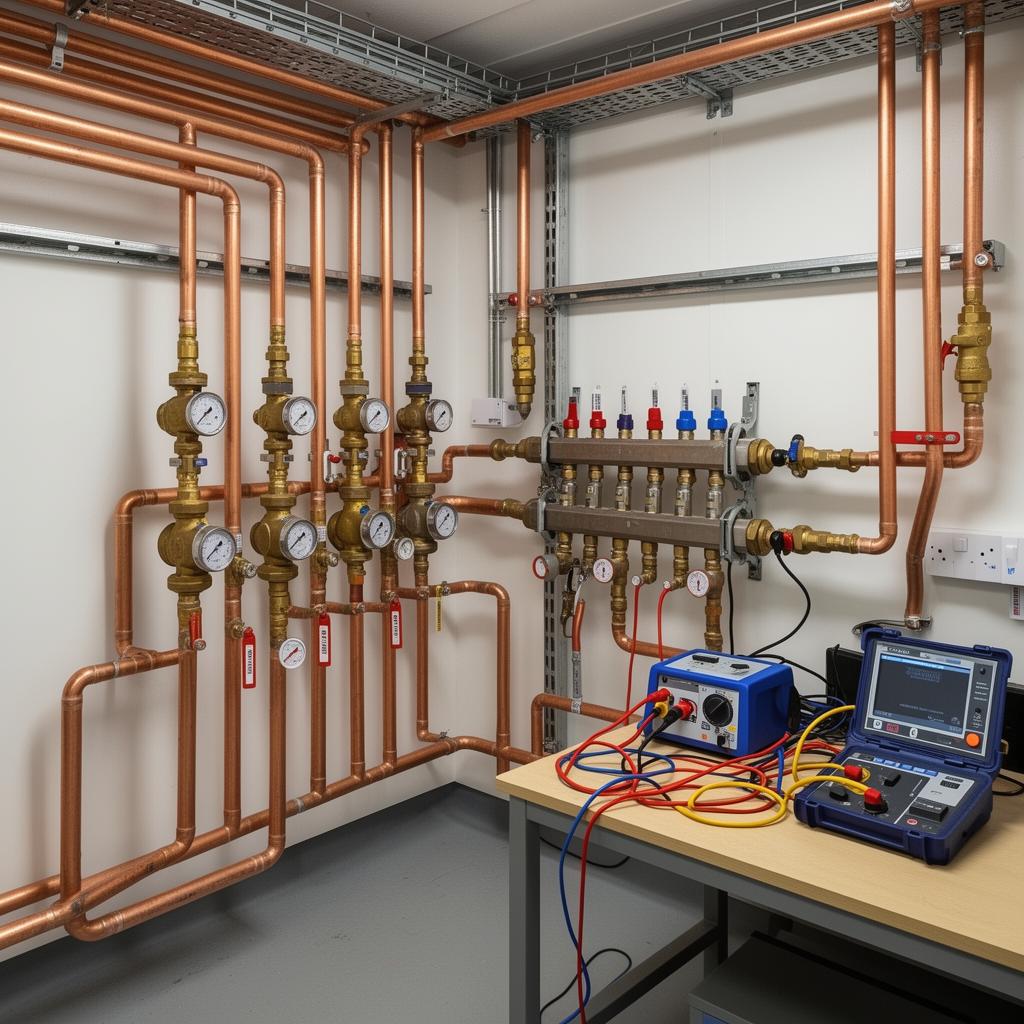
Gas Purging Wembley for Commercial Premises
Gas purging is the controlled displacement of air or gas from pipework. Before an installation enters service, air must be removed safely so the gas supply can be commissioned. When pipework is taken out of use, residual gas must be displaced through a planned procedure rather than simply released inside the building.
We support commercial premises around Wembley Stadium, Wembley Park and Wembley Central, including restaurants, hotels, shops with gas-fired equipment and managed buildings with commercial boiler plant. The method depends on pipework volume, pressure, configuration and the purpose of the work. A small catering branch and a larger plant-room supply require different assessments, even when both serve businesses on the same street.
Planning Gas Pipework Purging in Wembley
Wembley has distinct commercial settings. Olympic Way and the stadium surroundings have visitor-focused premises and managed developments; High Road and Ealing Road include busy retail frontages and food businesses. Commercial premises also sit around Wembley Stadium station and along the wider Wembley Park area. These settings affect access, delivery arrangements and where a safe working area can be established.
HA9 covers Wembley Park and much of the stadium area, while HA0 includes parts of Wembley Central and Alperton. A postcode alone does not establish site conditions. We need the full address, the location of the meter and gas plant, and details of any shared access before planning attendance.
Wembley Stadium Event-Day Access
Stadium events can bring road restrictions, heavy pedestrian movement and additional parking controls. Tell us about loading bays, estate permits and any event-day access arrangements. A purge discharge location must remain safe throughout the work; a normally quiet service area may not be suitable when crowds or deliveries are expected.
How Commercial Gas Purging Is Assessed
The assessment establishes the gas type, operating pressure, pipe sizes, estimated internal volume and available isolation points. We also consider branches, dead legs, connected appliances and the condition of existing records. These details determine the appropriate procedure, equipment and whether inert gas is required as part of the purge sequence.
Direct and indirect purging are not interchangeable options chosen for convenience. The applicable standard and site assessment determine the method. Suitable instruments are used to monitor the purge and establish the required endpoint. The discharge arrangement must control risks from ignition, gas accumulation and, where inert gas is used, oxygen displacement.
Working Safely Inside Wembley Premises
Basement kitchens, enclosed service yards and plant rooms within mixed-use buildings need particular attention. Open doors or windows do not automatically make a discharge arrangement safe. Nearby air intakes, occupied flats, public routes and neighbouring premises must be considered when selecting and controlling the working area.
UK Gas Regulations, IGEM Standards and Records
Commercial gas work must meet the applicable legal duties, including the Gas Safety (Installation and Use) Regulations 1998 where they apply. Engineers must hold Gas Safe registration with the relevant competence categories for the installation and work involved. Registration should be checked for the specific commercial activity, not treated as blanket authorisation for every gas system.
IGEM/UP/1 addresses strength testing, tightness testing and direct purging of relevant industrial and commercial installations. IGEM/UP/1A covers tightness testing and direct purging of qualifying small, low-pressure installations. The applicable current standard is selected according to its scope and the installation characteristics; larger or more complex systems may require additional guidance and a specifically engineered procedure.
Purging records are not interchangeable with appliance safety records. Depending on the agreed scope, documentation may include test results, purge details and commissioning records. CP17 forms are commonly used for non-domestic gas safety reporting, while CP42 forms relate to commercial catering gas safety. Neither is a universal certificate proving that every aspect of a purge has been completed.
Commissioning, Alterations and Decommissioning
Purging may be needed when new commercial gas pipework is commissioned, an existing supply is extended, or redundant sections are removed from service. Work can involve restaurant kitchen supplies, hotel boiler installations and gas distribution serving commercial plant. We establish the boundary of the work so that unaffected areas are not assumed safe or available without verification.
Tightness testing and purging serve different purposes. Tightness testing assesses gas containment; purging changes the contents of the pipework. Where required, both form part of the planned sequence before a supply is returned to service. Connected appliances may also need commissioning or safety checks appropriate to the work undertaken.
Shared Supplies and Occupied Buildings
In mixed-use blocks, a commercial unit may share access routes or service spaces with other occupiers. Building management should confirm responsibilities, provide relevant drawings and agree shutdown arrangements. We do not assume that a labelled valve isolates only the intended business without checking the installation.
Site Access, Parking and Protected Settings
On High Road and Ealing Road, loading restrictions and active shopfronts can complicate equipment unloading. Around Wembley Park, private estate rules may apply alongside public-road controls. Clients should identify authorised parking and loading arrangements rather than assuming that attendance for gas work permits stopping on restricted roads.
Parts of the wider Wembley area, including the Barn Hill Conservation Area, have heritage considerations. Conservation-area status does not itself prevent internal gas work, but proposed external pipework routes or permanent discharge arrangements may need checks with the owner and Brent Council. Temporary purge arrangements still require a site-specific safety assessment and must not obstruct public access.
Book Commercial Gas Purging in Wembley
Call 0208 935 5572 to discuss gas pipework purging wembley. We are open 24 hours, seven days a week. Provide your address, building use, reason for purging and any available gas installation drawings. Tell us whether the premises remain occupied and whether work must fit an agreed shutdown.
We will discuss the information needed to establish scope, access and documentation. Availability around the clock does not remove the need for safe planning or permissions. If you smell gas or suspect an escape, treat it as an emergency rather than a routine purging enquiry and contact the National Gas Emergency Service on 0800 111 999.
Gas Purging in Wembley: frequently asked questions
When is gas purging wembley required?
- It may be required before commissioning new pipework, following certain alterations, or during decommissioning. The installation details and applicable procedure determine whether purging is necessary.
Can Wembley businesses stay open during purging?
- Sometimes, but only if safe separation and access controls are achievable. Gas-dependent operations may need to stop, and shared premises may require a coordinated shutdown.
Does purging replace a commercial gas safety inspection?
- No. Purging, tightness testing and appliance safety inspections have different purposes. The agreed scope should identify which checks and records your installation requires.
Can I arrange Wembley gas purging outside normal opening hours?
- Yes, enquiries are accepted 24 hours, seven days a week on 0208 935 5572. Scheduling depends on the assessed work, safe access and any required site permissions.
Need a commercial gas engineer in London?
Gas Safe registered commercial engineers, 24 hours a day. Call now or book online and we'll confirm a time.