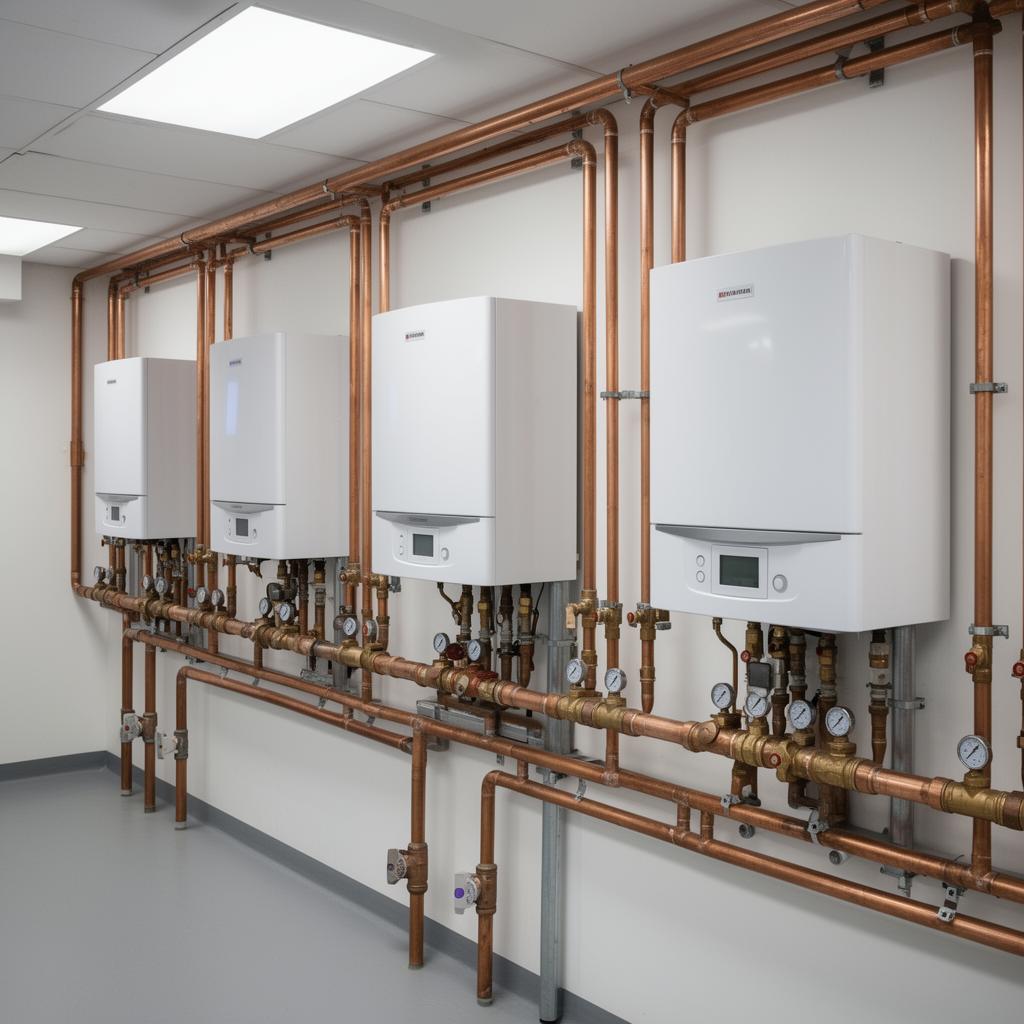
What commercial heating engineers do
Commercial heating engineers work on the gas heating plant that keeps a building warm and its hot water running: the boiler or boilers, the flue, the gas train and its safety controls, the pumps and diverter valves that carry heat to radiators, air handling units or calorifiers, and the controls that decide when and where that heat is delivered. The work covers installation, commissioning, fault finding, repair, annual servicing and the records that go with each of those.
It is a separate trade from domestic heating. Commercial plant is generally above 70kW net heat input, often runs two or more boilers in a cascade, and sits in a plant room shared with electrical, ventilation and fire systems. Engineers need non-domestic Gas Safe categories — usually commercial core (COCN1) plus the independent and commercial appliance categories (ICPN1 and CIGA1) for boiler plant, and the COMCAT categories where catering appliances are on site — and they need to read a whole system rather than a single appliance.
For a facilities manager the practical difference is continuity and paperwork. A commercial heating engineer logs gas pressures, burner settings, flue gas analysis and the operation of every safety device, so the engineer who arrives at three in the morning on a Sunday can see what the plant was doing before it failed, instead of starting from nothing.
The commercial heating systems we work on
London buildings are heated by four families of plant, and most sites mix two of them: boiler and calorifier plant feeding radiators or coils, warm air and radiant heaters filling large spaces, controls that decide when and where the heat goes, and the pipework and pumps that carry it. Our commercial heating engineers work across all four, so the fault is found wherever it sits rather than being passed from one trade to another.
Commercial boilers and calorifiers
Wall-hung modular boilers, floor-standing cast iron and stainless steel units, and cascades of two to six boilers controlled together are the backbone of most commercial heating in London. Calorifiers turn that boiler output into domestic hot water for hotels, gyms, schools and residential blocks. We install, service, repair and replace both, and we carry the parts that fail most often on London plant: gas valves, fans, ignition electrodes, diverter valves, pumps and control cards.
Warm air heaters, unit heaters and radiant tubes
Warehouses, workshops, churches, showrooms and sports halls are frequently heated by gas warm air heaters, unit heaters or overhead radiant tubes rather than radiators. These need their own routine checks — burner condition, heat exchanger integrity, fan operation and the safety cut-outs that stop them running unsafe — and they are usually the most economical way to make a high-ceilinged building usable in winter.
Heating controls, zoning and weather compensation
A building heats properly when the controls match output to demand: zone valves and motorised valves, room thermostats, weather compensation, time programming and cascade sequencing. Where one end of a building is stifling and the other is cold, the answer is normally in the controls and the balancing rather than in installing a bigger boiler, and we say so before quoting.
Pipework, pumps and balancing
Heating circuits only work if flow and pressure are right. We check pump operation and differential pressure, air separation, expansion vessels and pressure relief, then balance radiators, convectors and coils so each emitter receives what it was designed to give. Persistent noise, cold spots and a boiler that short-cycles are usually symptoms of a system problem rather than an appliance fault.
Signs your commercial heating needs an engineer
The calls we take most often are a boiler that locks out or trips its high limit thermostat, a building that never quite reaches temperature, hot water that runs out earlier than it used to, radiators that are cold at the top or cold at the bottom, pumps that have become noisy, and heating that comes on at the wrong hours. A fuel bill that climbs while occupancy is unchanged points the same way: either heat is being produced inefficiently or it is being sent where it is not needed.
Tell us what changed and when. Plant that began short-cycling the week after a controls change is a different job from plant that has been losing pressure for a month, and the engineer will investigate them differently. Photos of a data plate or a displayed fault code save time on the first visit.
How our commercial heating engineers diagnose a fault
We diagnose before we replace. The engineer reads the lockout history, checks supply pressure at the meter and at the appliance, tests the flue and combustion, compares flow and return temperatures against the design figures, and proves the safety devices that stop the boiler running unsafe — flame supervision, overheat thermostats, pressure switches and air switches.
Combustion readings are recorded against the manufacturer's limits, and no defective safety control is disturbed before it has been explained to you. If a component needs replacing, we show you the reading that proves it. If the fault lies in the system rather than the appliance, we tell you that instead of recommending a new boiler.
Planned commercial heating maintenance
Heating plant that is serviced on schedule fails less often, and fails in less inconvenient ways. Most commercial customers book an annual service before the heating season, with a mid-season check on whichever plant carries the heaviest load. Servicing follows the manufacturer's instructions for the exact model installed, not a generic checklist.
What a commercial heating service includes
Burner, electrode and heat exchanger inspection and cleaning, flue and condensate checks, gas rate and burner pressure checks, proving of every safety control, pump and valve checks, a review of controls and time settings, and combustion analysis recorded against the manufacturer's limits. Anything unsafe is reported the same day with a recommendation and a written cost.
Records you can hand straight over
You receive a written report after every visit showing what was checked, the readings taken, the defects found and the work completed. Landlords, insurers, local authorities and the next engineer can see exactly what was tested, which is what turns an annual service into evidence of compliance rather than a formality.
Installing or replacing commercial heating
A heating replacement is a building project as much as a boiler swap. We survey the plant room and the spaces it serves, confirm the heat load and hot water demand, and then set out the work in writing before anything is ordered, so the install is planned around your trading hours rather than discovered on site.
Sizing the plant
A new or replacement system is sized from a heat loss calculation of the building, plus hot water demand and a warm-up margin. Output is usually split across several modular boilers so the plant can run efficiently at low load and still keep heat on if one boiler fails. We survey the building and confirm the heat load before quoting.
Flues, ventilation and approvals
Gas fired hot water boilers above 70kW follow BS 6644, heating circuits follow BS 6880, and flue systems are designed to IGEM/UP/10, with combustion air and room ventilation sized to match the installed load. Where a plant room is shared with other services, we check the interaction with fire, ventilation and emergency controls before work starts.
Commissioning and handover
On completion the system is balanced, controls are set to the building's occupancy pattern, and you receive commissioning data sheets, combustion records, benchmark and building control documentation, and manufacturer warranty registrations where the manufacturer allows them. The handover pack is the document set your insurer or landlord will ask for.
Choosing a commercial heating contractor
Ask three questions before you book: which Gas Safe categories the engineer holds for your particular equipment, whether the written quote names the actual checks and readings rather than a job title, and who is responsible for the paperwork afterwards. A contractor who answers all three in writing is usually the one who still answers the phone when the plant fails in January.
If you already have a maintenance contract, we can still attend. We work as a second pair of hands for facilities teams, as the out-of-hours cover a contract does not provide, and as an independent pair of eyes when a plant has been repaired repeatedly for the same fault.
Areas our commercial heating engineers cover
Our commercial heating engineers cover Greater London and the surrounding counties, including every London borough and the City, and we work out of hours and at weekends so heating can be restored without closing the building. Call 0208 935 5572 with the site address, the equipment and what has changed, and we will confirm the arrival window.
Commercial Heating Engineers in London: frequently asked questions
Do commercial heating engineers need different qualifications to domestic gas engineers?
- Yes. Commercial heating work needs non-domestic Gas Safe categories — typically commercial core (COCN1) plus the independent and commercial appliance categories (ICPN1 and CIGA1) on boiler plant above 70kW, and the COMCAT categories where catering appliances are involved. A domestic-only engineer cannot lawfully carry out that work. The categories are printed on the back of the engineer's Gas Safe ID card and on every certificate we issue.
How often should commercial heating be serviced?
- Most manufacturers and insurers expect an annual service for commercial boilers and heating plant, carried out to the instructions for the exact model installed. Systems running under heavy load — hotel and school plant, swimming pool halls, large cascades — often benefit from a mid-season check as well. The right frequency depends on what you run and how hard it works, and the engineer will recommend one after the first inspection.
Do your commercial heating engineers work outside London?
- Our commercial heating engineers cover Greater London and the surrounding counties as standard, and we travel further for planned projects and multi-site portfolios. Call 0208 935 5572 with the site address and we will confirm coverage and the expected arrival window before anything is booked.
What paperwork do I get after commercial heating work?
- Every visit ends with a written report showing what was checked, the readings taken, any defects found and the work completed. Installations also come with commissioning data sheets, combustion records and the building control notification. That is the pack landlords, insurers and local authorities ask to see, and it is what makes the next fault easier to diagnose.
Will you repair commercial heating or do you only replace it?
- Both. We diagnose first and repair where the plant is worth keeping, and we recommend replacement only when a boiler is past its economic life, running inefficiently or no longer supportable. You get the reading that justifies the recommendation, and a fixed written quote for planned work before anything is started.
Need a commercial gas engineer in London?
Gas Safe registered commercial engineers, 24 hours a day. Call now or book online and we'll confirm a time.