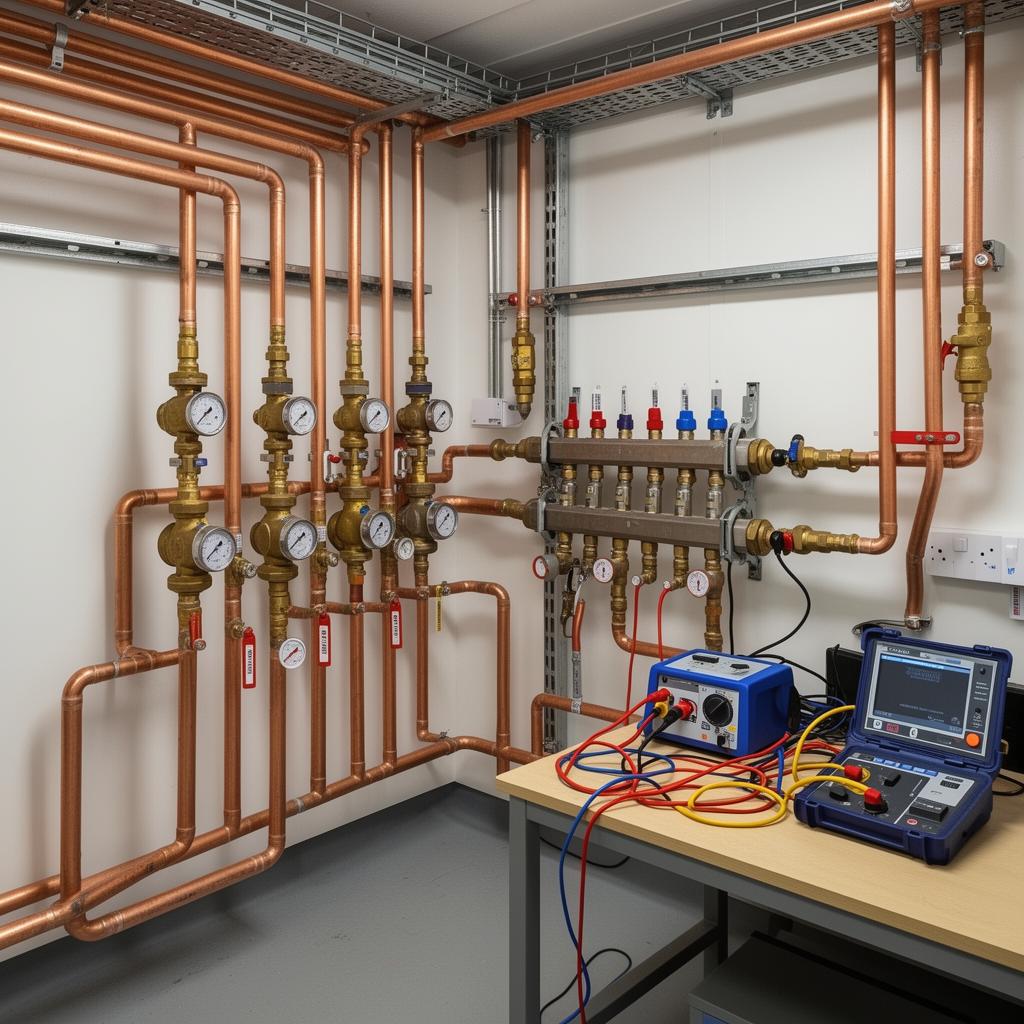
Commercial gas pipework installation regulations: The statutory duty behind pipework installation
The Gas Safety (Installation and Use) Regulations 1998 require that gas fittings, including pipework, are installed so as to be safe, and that work is carried out by someone competent to do so — in practice, a Gas Safe registered engineer for work on commercial premises. These regulations are deliberately broad in their safety requirement, with the detail of how to meet it set out in supporting technical standards.
Technical standards governing installation
BS 6891 provides detailed guidance on the installation of low pressure gas pipework, including sizing, support spacing, jointing methods, and protection from damage and corrosion, and is widely referenced for commercial pipework at domestic-equivalent pressures. For larger and higher pressure commercial and industrial installations, IGEM/UP/2 provides the relevant sizing and installation guidance, while IGEM/UP/16 addresses specific requirements for pipework in particular applications.
Engineers working on commercial gas pipework installation regulations compliance should always confirm which edition of each standard is current, since these documents are reviewed and updated periodically by their respective publishing bodies.
Pipework support and spacing
Regulations and standards specify maximum spacing between pipe supports or clips, which varies according to pipe diameter and material, to ensure pipework does not sag, vibrate excessively, or place strain on joints over time.
Routing pipework through buildings
Commercial gas pipework installation regulations address how pipework may be routed through a building, including restrictions or additional precautions where pipework passes through ventilation ducts, lift shafts, or other locations considered unsuitable, and requirements for sealing and fire-stopping where pipework passes through fire-rated compartment walls or floors.
Pipework in areas with higher risk of mechanical damage, such as near vehicle movement in a loading bay or within reach in a public area, typically needs additional physical protection, such as casing or being routed away from the risk entirely where practical.
Jointing, testing and protection against corrosion
Joints in commercial gas pipework must be made using methods and materials appropriate to the pipe type and the standard being followed, and newly installed or altered pipework must be tightness tested before being brought into use. Where pipework is installed below ground, passes through damp areas, or is otherwise exposed to a corrosive environment, appropriate protective coatings or materials are required to prevent deterioration over the installation's working life.
Documentation and ongoing compliance
Keeping records of pipework installation — including sizing calculations, materials used, and test results — supports ongoing compliance and makes future alterations or fault investigations considerably easier, since engineers working on the system later can understand what was installed and why.
Getting compliant pipework installed
Our Gas Safe registered engineers design and install commercial gas pipework to the current editions of BS 6891 and IGEM/UP/2, with full testing and documentation on completion. Call 0208 935 5572 to discuss a new installation, alteration, or compliance review.
Identification and marking of pipework
Commercial gas pipework is typically identified using colour coding or labelling appropriate to its contents, helping anyone working on or near the system — including other trades — recognise it as a gas line rather than another service. Clear identification becomes particularly important in plant rooms or risers where multiple pipework systems for gas, water, and other services run alongside each other.
Where pipework is concealed behind finishes or beneath flooring, accurate as-installed records showing the route become the practical equivalent of visible marking, since future work on the building needs to know where gas pipework runs even once it is no longer visible.
Alterations to existing pipework
Any alteration to existing commercial gas pipework — extending a run, changing diameter, or re-routing around other building work — must be carried out to the same current standards as a new installation, and the affected section tightness tested before being brought back into use. Older pipework being tied into should also be assessed to confirm it remains in suitable condition to carry the additional or altered demand.
Commercial Gas Pipework Installation Regulations: frequently asked questions
What standards underpin commercial gas pipework installation regulations?
- BS 6891 covers low pressure pipework installation in detail, while IGEM/UP/2 addresses sizing and installation for larger and higher pressure commercial systems, both supporting the statutory duty under the Gas Safety (Installation and Use) Regulations 1998.
Do regulations restrict where pipework can be routed?
- Yes, pipework routing through ventilation ducts, lift shafts, or areas at risk of mechanical damage is restricted or requires additional protection under current installation standards.
Does new pipework always need to be tightness tested?
- Yes, newly installed or altered commercial gas pipework must be tightness tested before being brought into use, following the procedure in IGEM/UP/1 or the relevant equivalent standard.
Why does documentation matter for pipework compliance?
- Clear records of sizing, materials, and test results make future alterations and fault investigation considerably easier, and support ongoing demonstration of compliance.
Does concealed pipework need to be marked or recorded?
- Yes, where pipework is hidden behind finishes or beneath flooring, accurate as-installed records showing its route are essential so future work on the building can identify where gas pipework runs.
Need a commercial gas engineer in London?
Gas Safe registered commercial engineers, 24 hours a day. Call now or book online and we'll confirm a time.