Best commercial gas boilers: Why There Isn't a Single 'Best' Commercial Boiler
Searches for the best commercial gas boilers or the best commercial boilers usually assume there's a single winner, in the way a best-selling consumer product might be ranked. Commercial heating doesn't work that way: a boiler that's excellent for a school's variable daytime demand may be the wrong choice for a hotel needing constant high-volume hot water, and a compact modular cascade suited to a tight city-centre plant room may be unnecessary for a warehouse with space to spare. We avoid recommending or ranking specific brands as 'best' because the right answer genuinely depends on your building.
Instead, it's more useful to understand the criteria that determine suitability - output and turndown, efficiency, footprint, controls compatibility, and manufacturer support - and apply those criteria to your own premises, ideally with advice from an engineer who has assessed your actual heat demand and plant room.
Criteria That Matter When Comparing Commercial Boilers
Output and Turndown Ratio
A boiler's maximum output needs to match your building's peak heat demand, but its turndown ratio - how low it can modulate without cycling inefficiently - matters just as much for buildings with variable demand, like offices or schools, where load varies hugely between a cold morning and a mild afternoon.
Condensing Efficiency
Modern condensing commercial boilers recover additional heat from flue gases compared with older non-condensing designs, which generally improves running efficiency. Whether a condensing boiler delivers that benefit in practice depends on your system's return water temperatures being low enough to achieve condensing conditions for a meaningful proportion of the time.
Footprint and Plant Room Constraints
Available plant room space, ceiling height, and access routes for installation and future replacement all affect which boilers are physically practical, regardless of their performance on paper. A highly efficient boiler that can't be manoeuvred into your plant room isn't a realistic option.
Cascade vs Single Large Boiler
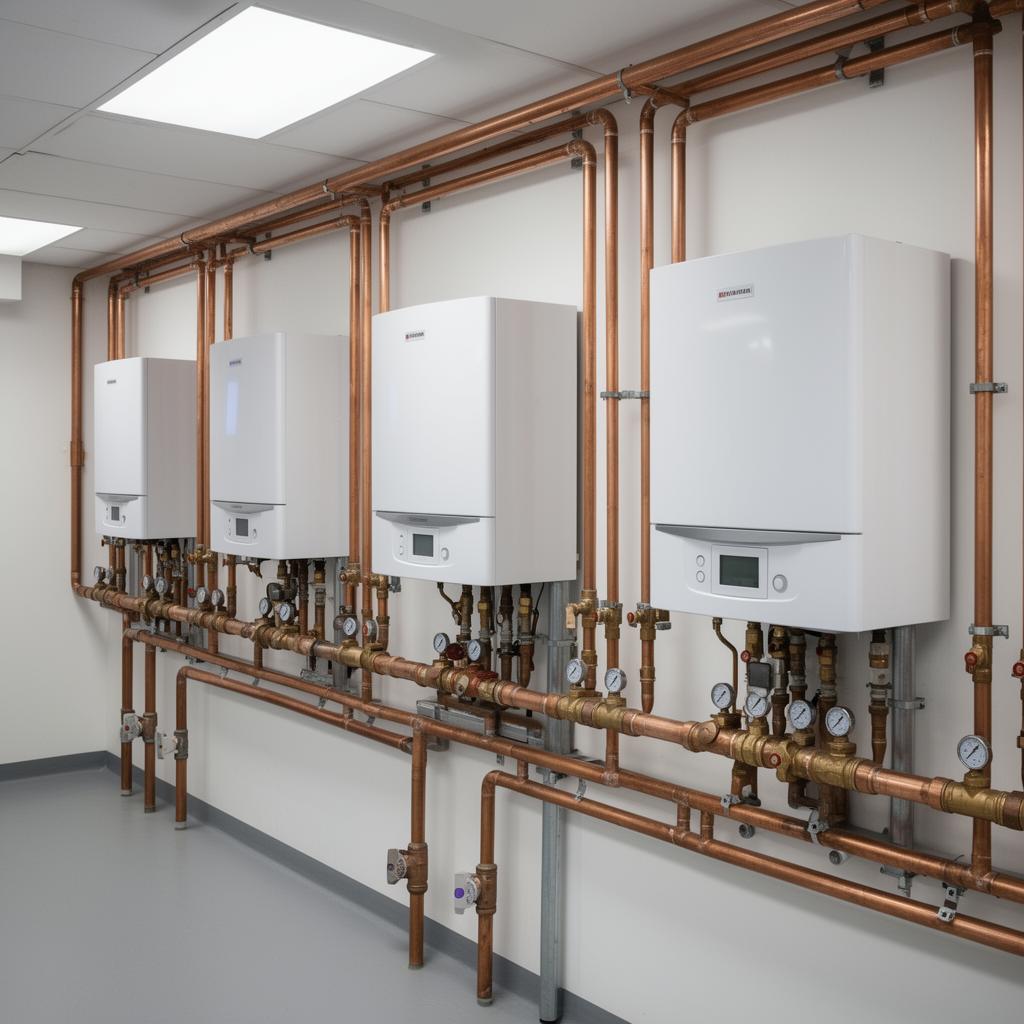
Multiple smaller boilers in a cascade arrangement can offer resilience (if one unit fails, others continue running) and efficient part-load operation, while a single large boiler can be simpler to install and maintain. Which suits your building depends on your resilience requirements and maintenance preferences.
Controls and BMS Integration
If your building has a building management system (BMS), checking that a prospective boiler's controls can integrate properly avoids costly workarounds later. Compatibility with weather compensation, zone control and remote monitoring is worth confirming before committing to a model.
Manufacturer Support and Parts Availability
Long-term serviceability matters as much as the installation itself. Checking that spare parts remain available, that the manufacturer has a track record of supporting commercial ranges, and that local engineers are trained on the model can avoid difficulties years down the line.
Matching the Boiler to the Building Type
A restaurant with intensive catering hot water demand has different priorities from an office with daytime-only heating, which in turn differs from a care home needing continuous, reliable warmth. Rather than searching for one universally best commercial gas boiler, it's generally more productive to describe your building's actual usage pattern to an engineer and let that shape the shortlist of suitable models and configurations.
How We Approach Boiler Selection
When we advise on boiler selection, we start with a heat loss assessment or review of existing consumption data, look at your plant room constraints, and discuss your priorities - whether that's lowest running cost, resilience, compact footprint, or ease of future maintenance. We work across a wide range of commercial boiler manufacturers and can explain the practical differences between models relevant to your specific project, without steering you toward one brand as universally 'best'.
Boiler Types Commonly Used in Commercial Settings
Commercial gas boilers broadly fall into a few categories: standard floor-standing boilers, wall-hung commercial boilers for smaller plant rooms, and cascade systems where several smaller modules work together to meet larger heat demand with built-in resilience if one module needs attention. Which category is appropriate depends heavily on your building's heat load, available plant room space, and whether you want redundancy if one boiler needs servicing or develops a fault.
Cascade Systems vs Single Large Boilers
Benefits of Cascade Arrangements
Splitting output across several smaller modules can offer better part-load efficiency and some resilience, since one module can be serviced or repaired while others continue to run.
When a Single Larger Boiler Suits Better
Where plant room space is limited or the heat demand is fairly constant, a single appropriately sized boiler can be simpler to install, control and maintain than a multi-module cascade.
Efficiency and Condensing Technology
Most modern commercial gas boilers use condensing technology to recover additional heat from flue gases, which can improve efficiency compared with older non-condensing designs. The real-world efficiency benefit depends on your system's return water temperature being low enough for condensing to occur consistently, so system design - not just the boiler itself - affects how much benefit you see in practice.
Matching Boiler Choice to Your Building
Rather than searching for a single best commercial gas boiler, it's more useful to start from your building's heat demand, hot water needs, plant room constraints and any resilience requirements, and then compare suitable models against those criteria. A boiler that performs well in one setting - a school with daytime-only occupancy - may not be the right choice for a hotel needing continuous output around the clock.
Installation and Commissioning Considerations
Even a well-chosen boiler needs correct sizing, pipework design and commissioning to perform as expected; an oversized or undersized boiler, or one commissioned without proper flue and ventilation checks, can underperform regardless of brand. We can advise on sizing and installation requirements as part of choosing a replacement or new boiler for your premises.
Choosing the Best Commercial Gas Boilers for Your Building: frequently asked questions
What are the best commercial gas boilers for a restaurant kitchen?
- It depends on hot water demand and space; we assess catering load and plant room constraints rather than recommending one brand as best for every restaurant.
Are condensing boilers always the best commercial gas boilers option?
- Condensing boilers are generally more efficient, but the benefit depends on your system's return temperatures; an engineer can confirm whether condensing operation is achievable in your setup.
Is a single boiler or cascade system better?
- Both have merits - cascades offer resilience and part-load efficiency, single units are simpler - so the right choice depends on your building's demand pattern and maintenance preferences.
Do you recommend specific commercial boiler brands as the best?
- We explain the selection criteria - output, efficiency, footprint, controls and support - rather than ranking brands, since the right fit depends on your building.
How do I find the best commercial gas boilers for my building?
- Call 0208 935 5572 for a site assessment; we'll discuss your heat demand and plant room before suggesting suitable options.
Need a commercial gas engineer in London?
Gas Safe registered commercial engineers, 24 hours a day. Call now or book online and we'll confirm a time.